

Dissatisfaction with Government Communication
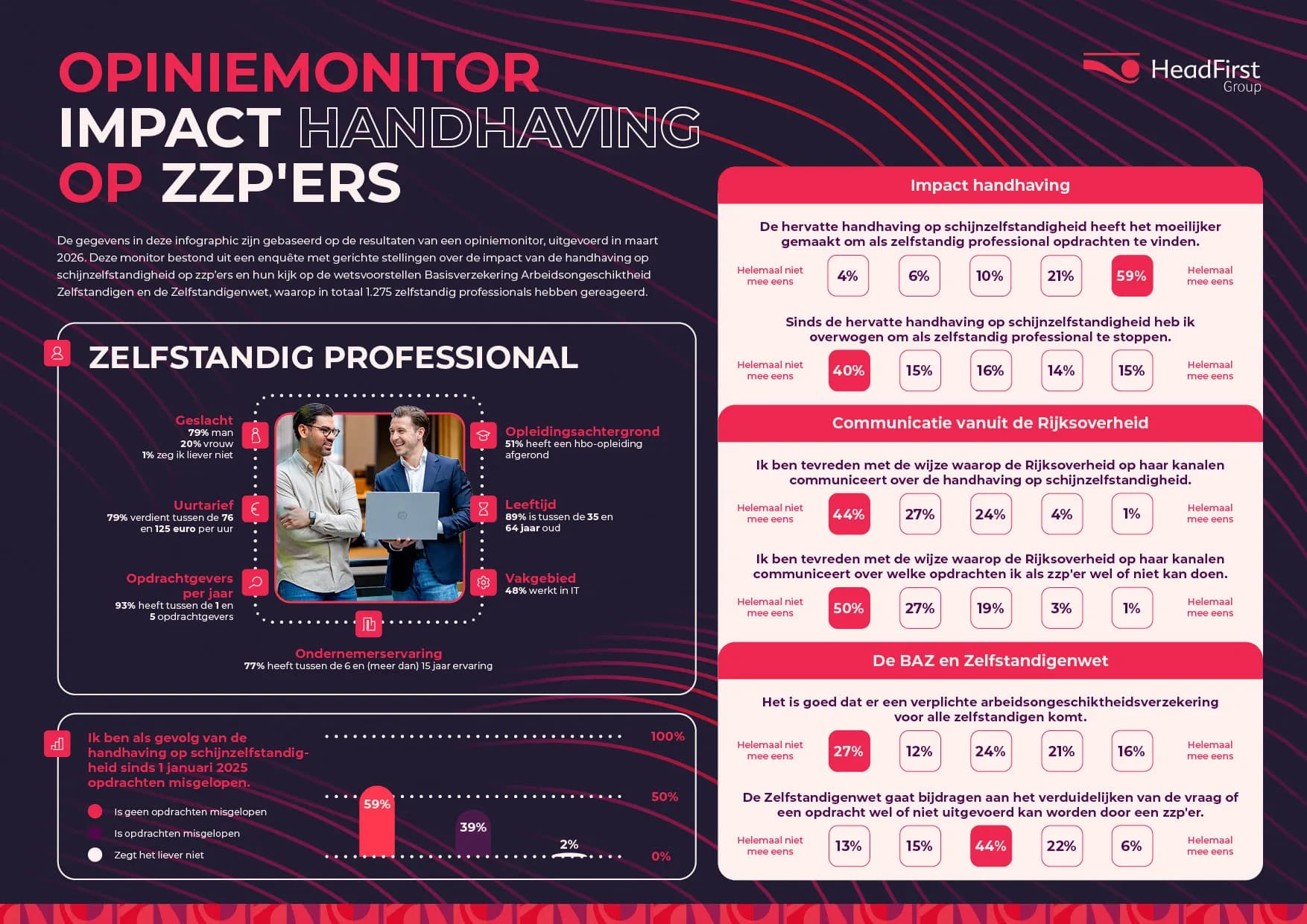
Despite this increased pressure, leaving self-employment does not seem to be a serious consideration for most people. Four in ten say they are not thinking about it. Those who would like to continue working as self-employed individuals do, however, expect clarity from the government. There is still much room for improvement in this area. More than two-thirds (69%) say they are familiar with the enforcement strategy, but at the same time, 71 percent are dissatisfied with the way the government provides information through its own channels regarding the enforcement of bogus self-employment. Self-employed individuals are even more critical when it comes to practical interpretation. 77 percent say they do not know which assignments they are or are not allowed to perform as self-employed individuals.
Mixed views on the BAZ and Self-Employed Persons Act bills
Self-employed individuals were also asked for their opinions regarding the bills on Basic Disability Insurance for the Self-Employed (BAZ) and the Self-Employed Persons Act.
Opinions are divided on these issues as well. Regarding the BAZ—which was officially submitted to the House of Representatives on Friday, March 13—nearly 38 percent are in favor of mandatory disability insurance, while 39 percent consider it a bad idea. At the same time, the vast majority of self-employed individuals have already made their own provisions for disability and retirement. Nearly 60 percent are saving, and nearly 50 percent already have private disability insurance.
The Self-Employed Persons Act, which aims to clarify which types of work a self-employed person is permitted to perform, has yet to win people over. Only slightly more than a quarter of self-employed individuals (28%) expect this law to achieve that goal in practice.
Sem Overduin, Manager of Public Affairs & Public Policy at HeadFirst Group: “The results paint a clear picture of the sentiment among highly educated self-employed professionals. Clients are more hesitant to hire self-employed professionals, and that uncertainty directly translates into fewer assignments. At the same time, the opinion survey shows that there is a great need for clear communication from the government, especially at a time when a lot of misinformation is circulating on social media. We call on the government to communicate actively, concretely, and clearly about what is and isn’t possible. With clear information, the market can once again work with independent professionals in full confidence, because in a tight labor market, we desperately need every worker.”
About the Survey
The opinion survey was conducted in March 2026 on behalf of HeadFirst Group. The survey included targeted questions regarding the impact of enforcement on bogus self-employment and the legislative proposals for the Basic Disability Insurance for the Self-Employed (BAZ) and the Self-Employed Persons Act. A total of 1,275 self-employed professionals responded to the survey.
About HeadFirst Group
HeadFirst Group is a leading international HR tech service provider and the largest platform for professionals in the Benelux, operating in fifteen European countries. The organization offers a variety of HR solutions, such as Managed Service Providing, Recruitment Process Outsourcing, intermediary services (matchmaking, contracting), and HR consulting. More than 35,000 professionals work for over 500 clients in Europe, generating an annual revenue of more than 2.6 billion euros for HeadFirst Group. HeadFirst Group’s key brands include the MSP (including intermediary services) labels HeadFirst and Staffing Management Services, RPO and recruitment specialist Sterksen, IT talent sourcer StarApple, and the Belgian HR tech company ProUnity.
Author
Natasja Spooren-Wassenaar