


Banner Mask

In short

The labour market continues to change rapidly due to legislation, digitalisation, and persistent shortages. Professionals have more choice, rates move with the market, and organisations must adapt quickly to find and retain talent. Hiring becomes a strategic instrument: those who plan ahead, use data, and offer smooth collaboration have the best chance of attracting scarce talent. The Talent Monitor helps organisations with up-to-date insights so they can act confidently and flexibly in a constantly changing market. 

Veranderende wetgeving, economische ontwikkelingen en nieuwe technologieën hebben directe invloed op hoe organisaties talent vinden, binden en behouden. Flexibele inhuur is daarin een strategisch hulpmiddel om de continuïteit en innovatie binnen jouw organisatie te versnellen.

Professionals hebben vandaag de dag meer keuze. De werkomgeving verandert, verwachtingen verschuiven en de besluitvorming moet sneller. In een wereld waarin verandering een vast gegeven is, vraagt dit om een inhuurstrategie die met je organisatie meebeweegt en vooruitkijkt.

In dit artikel nemen we je mee in de belangrijkste trends, delen we relevante arbeidsmarktinformatie en geven we advies om je strategieën toekomstbestendig te maken. 

The Dutch Labour Market in Motion 


Due to ageing, valuable knowledge is disappearing from organisations, while the demand for expertise in IT, data, finance, and procurement continues to grow. This leads to persistent shortages in certain fields.

More and more professionals are also opting for autonomy, flexibility, and meaningful assignments. Technology accelerates this movement and prompts organisations to adapt in time. This requires strategic choices.

Increasing Competition

In the aforementioned domains, demand regularly exceeds supply. Interim professionals often have multiple options. A slow process or unclear scope may cause talent to choose a different assignment. 

Invest in speed, transparency, and clear communication. This enhances the attraction and retention of (scarce) talent and automatically makes your way of working a strategic success factor. 

Tariff development and market dynamics 

In specific niches, we are seeing rising tariffs. Professionals are becoming increasingly aware of their value, thanks in part to economic developments and the growing demand for specialist knowledge. 

It is important to look beyond just the costs. A role that remains unfilled for months can lead to delays, increased workload, and even absenteeism within teams. Current market data provide direction for realistic budgets and make your internal decision-making more transparent. 

The Battle for Talent: Employer of Choice 

In a market where professionals have options, it's important to position yourself as an attractive employer compared to your competitors. Transparent assignments, swift feedback, and professional onboarding make the difference. And... positive experiences are shared.  

What does this require from your organisation? 

The job market demands a future-oriented strategy: 

Plan ahead and avoid ad hoc changes
Work closely with departments such as HR, business and procurement.
Use data and research to predict market movements
Involve partners who combine market knowledge, technology and networks

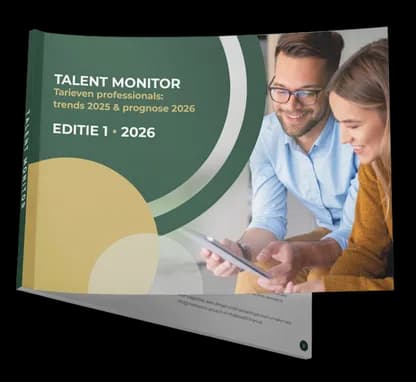
Talent Monitor: insight that helps organisations move forward 

With our Talent Monitor, we map out trends, rate developments and the availability of self-employed professionals. By combining data with practical experience, a current picture of the market emerges.  

The Talent Monitor helps you understand trends, mitigate risks and make confident decisions about external hiring based on up-to-date data. 

Insights from our Talent Monitor:

What are the trends in the labour market in 2026?

Number of freelancers decreases due to stricter enforcement 
Since the suspension of the enforcement moratorium, the number of freelancers has decreased by around 80,000. That is almost 8% of the total number of freelancers. Especially professionals with an MBO education are more frequently transitioning to salaried employment. 

Flexible labour turns into a buyer's market 
The market is experiencing less scarcity. For instance, clients are receiving four times as many offers per assignment as during the peak of the corona period. Rates are therefore under pressure, particularly in ICT. 

There is more demand for senior and mid-level talent than juniors 
The demand for juniors is decreasing due to: 

  • A built-up labour reserve
  • Automation and AI 

Mid-level and senior professionals are therefore benefiting from higher rates. 
What are the prospects for the labour market?

Limited rate increase: average +1.0% 
Although scarcity and inflation are declining, rates generally remain stable due to linkage to collective labour agreement indexes. 

Decreasing vacancy pressure 
The vacancy rate has already dropped from 44.5 to 43.3 and is likely to decrease further. This means: 

  • Less scarcity
  • More competition
  • Lower pressure on rates 

Increase in uncertainty among professionals 
More and more self-employed individuals are actively seeking work, indicating growing uncertainty. 

  • Differences per sector continue to grow
  • Healthcare and technology continue to experience significant shortages

Wat zijn de 3 meest kansrijke beroepen?

Based on rate increases, demand development, and market potential: 

  • Specialised nurses 

    High rate: €103.60 
    Rate increase: +10.1% 
    Healthcare remains structurally tight. 
     

  • Customer service employees (senior or complex) 

    Rate increase: +15.8% 
    AI is changing the work, but senior expertise remains necessary. 
     

  • Technical draftsmen and construction and installation technology 

    Rate increase: +12.9% 
    Strong demand due to energy transition and housing construction 

Which professions may disappear in the future?

  • Customer service and call centre (junior): AI tools and chatbots automate frontline work. Senior profiles remain necessary.
  • Secretarial roles: Generative AI and automated document management lead to a structural decline in demand.
  • Administrative roles: Tasks such as financial administration and basic HR administration are increasingly automated by software and AI.